-
關於
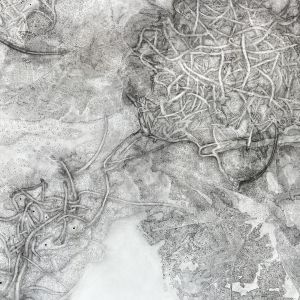
藝術家林麗容,自2018年以來,聚焦於「東方水墨」與「西方銀針筆」所締結的藝術創作,命其為名「墨沁銀針筆藝術創作」藉此追尋記憶中的生命經驗感受,透過作品與觀者感受連結。藉由自身作品脈絡之耙梳,逐步建構「墨沁銀針筆藝術創作」的創作形式,並探討如何在「傳統與當代」潮流交會的藝術洪流中,尋得自身的定位與意義。以下文章《沈睡的記憶》,藝術家將回溯其童年時期因受父親筆墨薰陶影響而萌發繪畫興趣,並敘述個人生命歷程如何影響對「墨沁銀針筆」創作的形構與思維轉變。
《沈睡的記憶》 撰文者 林麗容
記憶中,烙印著些許童年與過往歲月的痕跡,彷彿冰山一隅深沒於水平面下,隱匿著許多尚未被意識所觸及的潛藏經驗。這些難以即時察覺的記憶,卻在創作過程中隨著思緒的流動,不經意地顯現在創作之中。心理學家佛洛伊德(Sigmund Freud, 1856–1939) 曾指出:「童年時期的心理活動並不輕易消逝,必將烙痕於個人的發展史上,永遠影響他的未來。」 ,這番論述令我更加深信,在我童年記憶的深處,早已埋藏著「線」的創作伏筆。
(一)萌發的線端:
童年歲末,屋裡總有一股淡淡的漆味,斑駁的灰牆上披掛著一疊疊紅色的蠟紙,冰冷的水泥地板隨著臘月的腳步漸漸熱絡,滿地討喜的紅色字聯隨著人來人往的腳步不斷更迭。小臉頰依著手背輕靠案桌,凝視著執筆的父親揮毫落下的漆漬,黝黑光亮的漆形如豆、如鉤、如線、如刀狀錯落於紙,如是閃耀!每每趁著父親擱筆閒置,不聽使喚的小手伺機信手塗鴨。青少時期的歲末,父親執筆依舊但有別以往而採以亮粉飾化,父親將待乾的春聯撒上金粉亦或攪拌成泥,從而手執細筆蘸著金泥小心翼翼地將寫好的字聯描繪邊「線」,順著父親的口訣:「橫畫;線於下、豎畫;線於右」,爾後的寒冬歲末時光,經常伴隨父親專注書寫的身影,成為我生命中不可磨滅的場景。也許正是在這書畫同源、墨香氤氳的氛圍中耳濡目染,父親的身教與美感熏陶,使我自小便對繪畫產生濃厚的興趣與深切的情感追隨。
(二)、寧靜的白盒子:
萌發於童年的那條「線」,從未鬆手,始終牽引著我前行。猶然記得與「白盒子」初次相遇的那一刻;純淨、開闊的空間深深撼動了我,彷彿在那無垠潔白之中,內心的混沌與孤寂獲得了片刻的寄託與慰藉。仍然記得1984年的某一天,我獨自佇立在明亮寬敞的展場中,四周的寂靜與潔白形成一股強大的凝聚力,給予我無以名狀的安定與歸屬感。那彷彿是一種能撫平傷痛的能量,靜靜地包覆著我,自離家後,每當心情低落時,我總會走入「白盒子」中尋找片刻安寧。多年來,它悄然地淡化了我內心的傷痕與糾結。而多年之後,那白盒子裡的「線」,仍牢牢牽引著我,帶領我不斷地走向創作的深處,找尋更真實的自我。
(三)、線的呼喚:
1985年,我進入迪士尼卡通公司擔任動畫工作。這段經歷形塑了我對「線條」的敏感與執著。動畫製作要求在潔白無瑕的紙張上,以鉛筆繪製出流暢、生動的線條。紙張的純白不容許任何塵埃,而鉛筆的筆尖更須細緻銳利,才能畫出粗細、濃淡一致、一氣呵成的筆觸。這樣近乎苛刻的工作要求,不僅培養了我對鉛筆線條的高度要求,也埋下我日後創作中對於「線」與「白」的深厚執念。
2018至2019年間,我開始嘗試以木板作為創作的基底,運用批土與 GESSO 在木板上反覆堆疊、細緻打磨,使其表面呈現如記憶中白紙般的潔白與細膩。這樣的創作方式,不僅喚醒了我多年來對紙與線的記憶,也開啟了《倒數》系列,以「鉛筆」為媒材的創作契機。
當時以「鉛筆」為創作媒材,想找回的也許只是記憶中的「曾經」,也許是曾經青澀的歲月、未曾泛黃的紙張、或曾經是烏彩的線端;然而,眼前的油彩稀釋了畫裡的「鉛筆」線條,正值陷入迷惘、困惑之際,承蒙東海大學廖敏君老師的建議,開始思索以西方具有古典與傳統的「銀針筆」作為替代媒材,以取代鉛筆媒材。於是我開始透過網路搜尋銀針筆的相關資料,也就此展開了對這項古老媒材的溯源之路,就在啟動網頁的瞬間,映入眼簾的是2016年曾令我駐足許久的當代藝術家卡蘿.普魯莎 的作品影像,那年我在展場中徘徊於她以銀針筆創作的半弧球體作品之前,白牆上的畫面至今仍歷歷在目,深植記憶。
(四)、不期而遇:
回溯至2016年的某一天,台北世貿展覽館人潮洶湧,隨著擁擠的觀眾緩步踏入會場。正當我穿梭於作品之間,轉入一處展場角落時,一面純白牆面上的半弧球體吸引了我的目光。灰色的弧面與其中蘊含的質感與色調,深深烙印在我記憶中,然而,我可以確定,它們並非隨手可得的鉛筆所能完成。這份驚奇與好奇在心中悄然發酵,也因此在心底種下了對「銀針筆」媒材的濃厚興趣,進而成為日後「墨沁銀針筆藝術創作」的核心媒材之一。
Artist Lin Li-rong has, since 2018, developed her practice Ink-Infused Silverpoint Art, a fusion of Eastern ink and Western silverpoint. Her works trace the emotions of memory and invite viewers to connect through subtle textures and layered surfaces. Beginning with wooden panels coated in layers of plaster and gesso, she carefully sands each surface smooth before applying ink and silverpoint. This process preserves the paper-and-pencil sensibility she embraced while working in Disney animation, while opening new ground between tradition and contemporary expression. Her series Sleeping Memories revisits the origins of her artistic journey, recalling how her father’s ink practice sparked her childhood fascination with painting and how life experiences continue to shape her evolving creative vision.
Sleeping Memories
Intro: Memory and Creative Flow
Traces of childhood and past years are imprinted in memory, like an iceberg whose tip barely emerges above the surface, hiding countless experiences that have yet to reach conscious awareness. These subtle memories, imperceptible in daily life, gradually surface during the creative process, emerging unintentionally within the work. Psychologist Sigmund Freud (1856–1939) once observed: “The psychological experiences of childhood do not easily vanish; they are indelibly inscribed in an individual’s developmental history and continue to influence their future.” This insight has deepened my conviction that, buried within the depths of my childhood memories, the seeds of “line” as a form of artistic expression were already sown.
Section 1: The Sprouting of Lines
At the end of each year in my childhood, the house would carry a faint scent of paint. The weathered gray walls were adorned with stacks of red wax paper, and the cold cement floors gradually came alive with the footsteps of the lunar year’s end. Cheerful red couplets scattered on the ground were constantly replaced as people passed by. Resting my small cheek against the back of my hand on the table, I would gaze at my father as he wielded his brush, watching lacquer spill onto paper—dark and glossy, taking forms like beans, hooks, lines, and blades—shimmering with brilliance. Whenever my father set down his brush, my little hands would seize the moment to doodle freely, ignoring admonitions. During my adolescence, my father continued to write at year’s end, now using shimmering pigments. He would sprinkle gold powder on drying couplets or mix it into a paste, carefully tracing the edges with a fine brush, following his instructions: “For horizontal strokes, line below; for vertical strokes, line to the right.” The cold winter season was often accompanied by my father’s concentrated figure writing the couplets, leaving an indelible imprint on my life. Perhaps it was within this shared origin of calligraphy and painting, immersed in the lingering fragrance of ink, that I was nurtured by my father’s example and aesthetic influence, cultivating from an early age a profound interest in painting and a deep emotional attachment to artistic practice.
Section 2: Translating Memories into Artistic Practice
These formative experiences naturally evolved into my creative practice. Since 2018, I have focused on the fusion of Eastern ink and Western silverpoint, which I have named Ink-Infused Silverpoint Art. Beginning with wooden panels coated in multiple layers of plaster and gesso, I carefully sand each surface smooth before applying textures and fine details with ink and silverpoint. This meticulous process also reflects my background in animation. Having worked on Disney cartoons, I developed a love for the delicate feel of paper and pencil—a sensibility I strive to preserve by working on white wooden panels. Through this method, the traces of memory, the precision of line, and the layering of materials converge to express subtle emotions and invite viewers into intimate connection with the work.
Section 3: The Call of the Line
In 1985, I joined Disney Animation, a journey that shaped my sensitivity and devotion to the “line.” Animation required drawing fluid and lively lines on pristine, immaculate sheets of paper. The flawless white surface allowed no dust or smudges, and the pencil tip had to remain sharp and precise to create strokes that were consistent in thickness, value, and rhythm. This almost demanding standard not only cultivated my high expectations for pencil lines, but also planted the seeds of my deep attachment to “line” and “white” that would surface years later in my creative practice.
Between 2018 and 2019, I began experimenting with wooden panels as the foundation for my work. By layering putty and gesso repeatedly on the surface and sanding it meticulously, I recreated a whiteness and delicacy that resembled the paper of my memories. This process not only awakened my long-held memories of paper and line, but also opened the path to The Countdown series—the beginning of my exploration using the pencil as a primary medium.
At that time, working with pencils was perhaps an attempt to retrieve something from the past—youthful years, paper that had not yet yellowed, or the once-dark edge of a pencil line. Yet the diluted paint softened those pencil marks, and as I found myself in confusion and doubt, Professor Liao Min-Chun at Tunghai University suggested I consider replacing the pencil with the Western medium of silverpoint, a material rooted in classical tradition. Following her advice, I began researching silverpoint online, embarking on a journey tracing the history of this ancient medium.
The moment the webpage opened, an image filled the screen—an artwork by contemporary artist Carol Prusa. It was a work I had stood before in 2016, lingering for a long time in front of her semi-spherical silverpoint piece. The scene of that artwork glowing against the white wall remains vivid to this day, deeply etched in my memory.
Section 4: An Unexpected Encounter
Looking back to a day in 2016, the Taipei World Trade Center Exhibition Hall was filled with crowds. I moved slowly with the flow of visitors as we entered the venue. While weaving through the artworks, I turned into a corner of the exhibition space, and there it was—a semi-spherical form mounted on a pristine white wall that immediately captured my attention. The gray curvature, along with its subtle textures and tones, became deeply imprinted in my memory. I knew with certainty that such effects could not have been achieved with an ordinary pencil.
This sense of wonder and curiosity quietly took root within me, sowing an enduring fascination with the medium of silverpoint. It eventually grew to become one of the core materials in my artistic practice, giving birth to what would later become my “Ink-Infused Silverpoint” creations.
